
Five years ago, I set out to solve what I believe is one of the most overlooked problems of our time: humanity’s inability to understand and regulate its own emotions.
I didn’t start with AI. I didn’t even start with technology. My career began on the ground; in communities where mental health support was practically nonexistent. I watched parents being told there was “nothing to be done” for their child’s suicidal ideation until they had made an attempt. I saw billions poured into mental health budgets while outcomes worsened. That was my turning point.
I became convinced that the solution to this escalating crisis would need to be scalable yet deeply personal – and that led me to technology.
Why AI Should Solve Real Problems, Not Just Build Features
Somewhere along the way, AI became synonymous with chatbots, productivity hacks, and hype cycles. Too many companies start with the tech and then go searching for a problem to apply it to.
We took the opposite approach. At inTruth, we asked:
What’s at the root of our mental health epidemic?
The answer wasn’t a lack of therapy sessions or another mindfulness app. It was something more fundamental:
- We don’t understand our own emotional states.
- We have no real-time visibility of what drives our reactions and decisions.
- We’re flying blind when it comes to emotional regulation.
Emotion drives around 80% of human decision-making, yet unlike time or language, it’s never been standardised. Without a common framework, our systems-from healthcare to education to leadership – are reactive instead of preventative.
That’s where technology can help.
The Missing Standard: Why Emotion Needs a Language
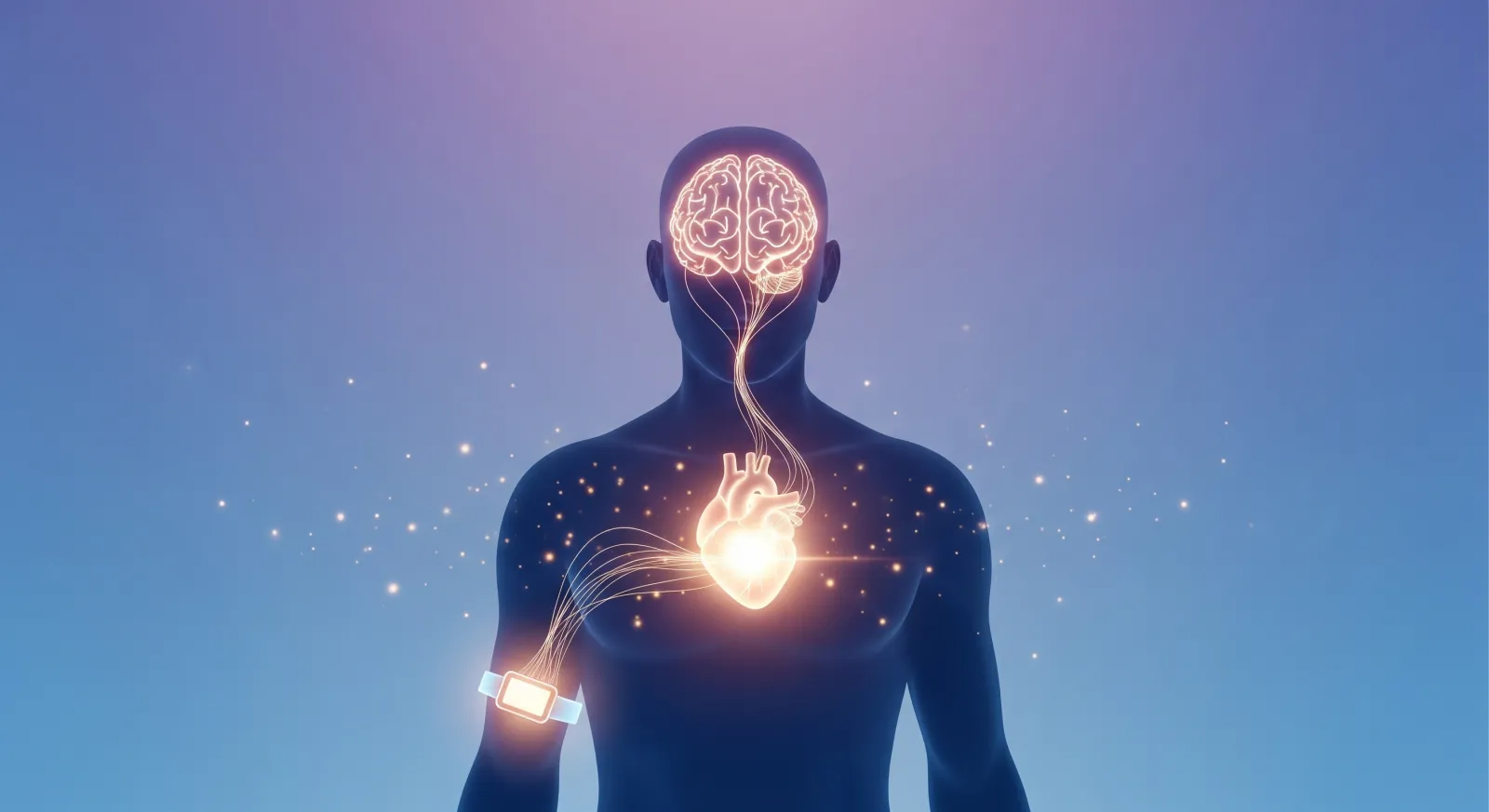
When I first started building inTruth, the wearable space was still emerging. I knew we needed to capture biometric signals that could be translated into emotion objectively – something psychology’s self-reporting methods could never fully achieve.
We landed on PPG sensors (the same tech in an Oura Ring or Garmin watch) and trained our model in clinical environments using EEG, ECG, and other biosignals. The breakthrough was realizing that arousal (stress) and valence (pleasantness) could be mapped into a spectrum of emotional states.
By using machine learning to connect these patterns with real emotional experiences, we created what we now call an Emotion Language Model; a visual language of emotion that will likely outgrow words.
Imagine a world where your emotional state is tracked as seamlessly as your heart rate. Not for surveillance, but for self-awareness and prevention.
Ethics by Design: Why Data Sovereignty Isn’t Optional
The first reaction I get when people hear about emotional biometrics is:
“That sounds Orwellian. I don’t want anyone knowing how I feel all day long.”
They’re right to be wary. The same data that could save lives could also manipulate elections, exploit consumers, and deepen societal divisions if used recklessly.
That’s why we’re building inTruth around data sovereignty and privacy-first infrastructure.
- Our federated learning model ensures emotional data stays on the user’s device while only anonymised learnings feed back to improve the system.
- We’re open-sourcing our ethics frameworks so other AI and biotech companies can adopt them.
- We’ve launched a policy group to push for legislation protecting emotional data from being sold or exploited.
It’s not enough to have good intentions – you have to design ethics into the DNA of your product.
Choosing Agility Over Perfection
As founders, we’re often tempted to build in secret until everything is perfect. But perfection is a mirage.
Our early prototypes were clunky. Some investors told us not to bother because “if it were possible, it would have been done already.” Something I believe every innovative founder comes up against; we launched anyway – learning, iterating, and letting real-world data shape the product.
Agility has been our superpower. It’s what allowed us to evolve from a model that could only delineate four emotional states to one now showing over a dozen distinct clusters-and growing.
The Real Competitive Edge
There’s a lot of noise in the emotion AI space right now. Many companies analyze sentiment through language or facial expressions. But these are behavioral analyses, not true emotion analysis. They’re noisy, delayed, and easily gamed.
Our differentiation lies in measuring emotion at its source – millisecond by millisecond – before the brain has time to rationalise or mask it.
It’s the difference between asking someone, “How do you feel?” and actually knowing.
Building for the World We Want to Live In
Every day, we face decisions that will shape the next hundred – or thousand – years of human history. The companies we build today are writing the blueprint for the future.
We’re at an inflection point where AI could either amplify our dysfunctions or help us evolve beyond them. For me, inTruth is a statement about what technology should be:
- Human-centered
- Ethically grounded
- Transformational, not extractive
Our goal is bold: to make emotional health as measurable and actionable as physical health, and to ensure the data empowering that shift remains in the hands of the individual.
Final Thoughts: Serving Humanity Through AI
When I look at the AI landscape, I see two types of companies:
- Those chasing hype, building features no one asked for.
- Those solving problems that matter – problems that, if solved, change the trajectory of humanity.
I know which side we’re on.
As founders, we have to ask ourselves: Are we building for profit, or are we building for people?
The best companies will do both – but they’ll start with the latter.
If this resonated with you:
Join my community of Founders: skool.com/institute
Listen to The Global Affair: The Global Affair Podcast